The ball machine for tennis was first created back in 1927. It served balls at a rate of around 14-28 balls per minute. The first commercially viable ball machine, however, wasn’t developed until 1970. It was called the “Little Prince” It was built by inventor and entrepreneur Bob McClure in his Princeton, New Jersey garage, who reversed the motor on a household vacuum cleaner to shoot balls.
For decades, however, ball machines have stayed relatively the same. They were programmed to do the same thing over and over again or to have “randomness within fixed parameters”, where the machine would randomly hit the ball with a certain speed and spin at a random place on the court. For the purpose of being able to train certain shots, these machines were extremely successful; but the exceedingly repetitive nature of these machines meant that actually replicating match-play was extremely hard.
For many decades, most brands only competed on durability and ball capacity, not innovation, because there was nothing meaningfully new to sell. This stagnation had a side effect that made ball machines stay a low-volume, high-margin niche product, reinforcing tennis’s reputation as a “country club sport” rather than something that scaled to a mass market.
From the 1970s to the 2010s, the only real improvements made to these machines lay in better hoppers, oscillating heads, or remote controls. There were no improvements made to react to the player or replicate actual match-play. The entry models for most ball machine brands start at around 300 dollars. Mid-range machines can cost around 1000 dollars and for high-end machines, upwards of 2500.
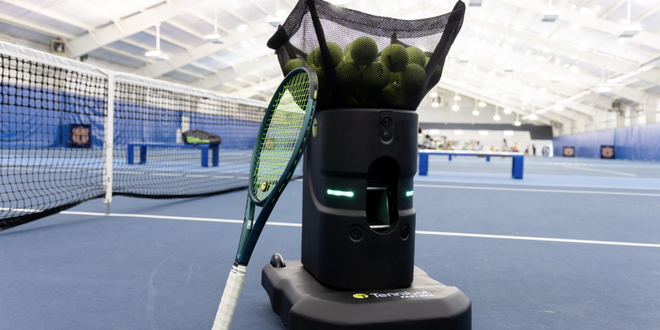
Then, in 2020, AI became extremely popularized and new innovations began being made. As an example, Tennibot, founded that same year, entered as a startup rather than a racquet-sports brand. They built a machine around computer vision as opposed to the traditional mechanical feed patterns that were popular at the time. Since then, a large number of other companies have also hopped on the trend and this use of AI and the machines being able to move, means that now actual match-play is attainable when there isn’t anyone else to play with. While the tennis ball machine market still remains as a very expensive market, the new innovations with AI have cut down on one of the biggest problems.