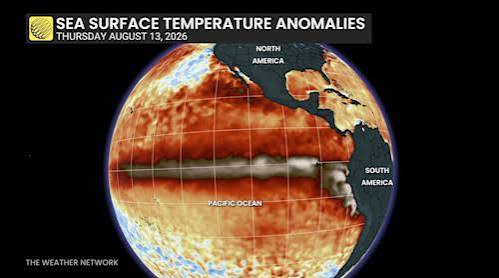
A rapidly strengthening El Niño became a major climate story in mid-August 2026 as scientists warned that the phenomenon could become exceptionally strong later this year. On August 13, the U.S. Climate Prediction Center reported more than a 90% chance of a very strong El Niño developing during the Northern Hemisphere’s fall and winter, with a 69% probability that the October–December period could reach historic strength.
El Niño is a natural climate pattern that occurs when surface waters in the central and eastern tropical Pacific Ocean become unusually warm. This warming changes atmospheric circulation and can disrupt normal weather patterns around the world. Although El Niño begins in the Pacific Ocean, its effects can reach far beyond the region, influencing rainfall, temperatures, storms, and drought conditions in many countries.
The potential strength of the 2026–27 event is particularly concerning because extreme weather is already affecting many parts of the world. El Niño can bring drought and unusually high temperatures to parts of Asia, Africa, and Australia, while causing heavier rainfall and flooding in other regions. In the Amazon, scientists are especially concerned that increased drought could worsen wildfires and place additional stress on the rainforest.
Scientists emphasize that El Niño is a natural phenomenon, but its effects are occurring alongside long-term global warming. As the world prepares for a potentially historic El Niño, governments and humanitarian organizations are increasing preparations for extreme weather, food shortages, and other consequences.