By Sofia Pan, G9
Recently, the announcement of the 2026 Nobel Prize in Physics honoring Francis Halzen has become a widely discussed milestone. Hundreds of news outlets rushed to cover the headlines immediately upon the prize’s release. Yet while the initial reporting captured the excitement, much of it skimmed the physics involved. Beneath the headlines lies an extraordinary experimental journey: the story of the IceCube Neutrino Observatory and why opening a lensless window on the cosmos earned physics’ highest honor.
The Nobel Prize was awarded to Professor Halzen “for decisive contributions to the IceCube Neutrino Observatory and the discovery of high-energy neutrinos of astrophysical origin.” In practice, this recognized decades of visionary leadership. In the late 1980s, Halzen championed the audacious concept of using Antarctic ice as a particle detector, steering the project from early feasibility tests to full scientific operation.
Neutrinos were not discovered until the mid-20th century. Because they are both electrically neutral (hence the “neutr-”) and physically diminutive (hence the “-ino”), they pass through conventional particle detectors unnoticed. Yet this elusive nature is precisely what makes them invaluable to astrophysics: unhindered by magnetic fields and unabsorbed by cosmic dust, neutrinos travel in straight lines across billions of light-years, serving as uncorrupted messengers from the most violent engines in the universe.
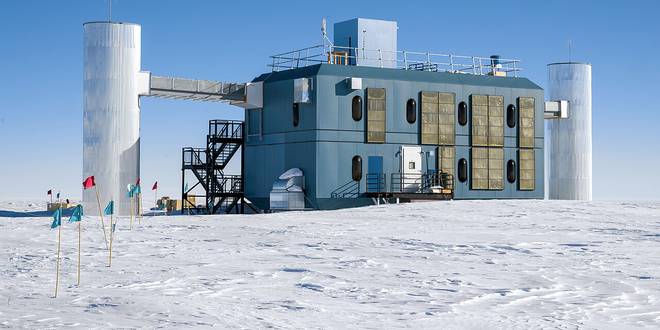
In order to capture the neutrinos, IceCube, the South Pole neutrino observatory, transformed a cubic kilometer of deep Antarctic ice into an instrumented particle detector. It is buried beneath the surface, extending to a depth of about 2,500 meters. When, on rare occasions, a high-energy neutrino directly crashes into a proton or a neutron inside an atomic nucleus (such as oxygen or hydrogen), it produces charged particles. As these charged particles tear through the ice faster than the local speed of light, they generate an optical shock wave—a faint blue flash known as Cherenkov radiation. An array of 5,160 Digital Optical Modules (DOMs) frozen into the deep ice detects, digitizes, and timestamps these flashes to reconstruct the incoming particle’s exact energy and path.
Since 2013, IceCube has systematically proven that high-energy neutrinos are arriving from deep in the cosmos. The observatory has pinpointed emissions from active galaxies powered by supermassive black holes—including the blazar TXS 0506+056 and the Seyfert galaxy NGC 1068 (Messier 77)—and in 2023 produced the first neutrino map of our own Milky Way. By allowing astronomers to look straight through dense environments that swallow ordinary light, IceCube provides a vital roadmap to resolving the century-old mystery of cosmic-ray origin and investigating why matter dominates our universe. In recognizing Francis Halzen, the Nobel Committee celebrated the latest chapter in a proud lineage of neutrino pioneers—standing alongside trailblazers like Clyde Cowan and Frederick Reines—who turned ghost particles into our newest window on reality.