By Sarah Zhu, Grade 9
Last time, we introduced the Chinese recovery method, and today, I would like to introduce Starship.
The first success of the Starship was on October 13th, 2024, which was the first time humans succeeded in recovering a rocket. And then, they succeeded twice, separately on January 16th, 2025, and March 6th, 2025. It’s not difficult to see that the tower-arm catch is a mature technique.
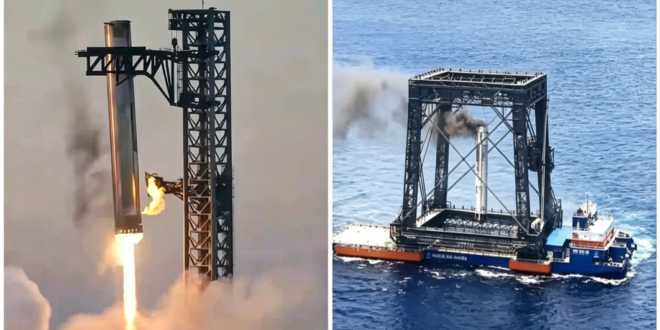
The process was quite different from the Chinese one. When it had only a few seconds before touchdown, its center Raptor engines began to slow down, guiding itself toward the launch tower. And then, the two large steel arms swung closed and grabbed the rocket’s body. Lastly, the two arms successfully caught the load-bearing pins. The whole process is just like Chinese people using their chopsticks to grab food, which is why people nicknamed it the “chopstick landing method”.
There are a large number of benefits. First, it can be reused rapidly because technicians don’t need to move it elsewhere. It can be directly placed back onto the launch pad. Meanwhile, boats on the sea and massive securing cables are not needed, so that saves unnecessary expenses.
On the other hand, it still has some apparent disadvantages. Because it is a rigid capture, any small mistakes will ruin the whole equipment, meaning all processes need to be accomplished precisely. Meanwhile, the two chain pins and “chopsticks” need to be extremely solid to absorb massive loads.
This strategy is challenging, but why did Musk choose it instead of using arresting cables? And why did China choose arresting cables instead of the tower arm, which had already succeeded? Which is better?
For the first question, there are several reasons. Initially, SpaceX wants to have high efficiency because their final goal is to launch satellite constellations, so they don’t want to waste time on transportation. Also, Starship’s weight is up to 200 tons, four times heavier than the Long March 10B, making it impossible for SpaceX to use a net system.
About the second question: the reason is that most Chinese launch stations are located on the ocean, such as the South China Sea, so they cannot guarantee the descent location is precise. Flexible buffering is the best solution to unexpected strong winds. Also, China’s aerospace is more about “no mistakes”. They are dedicated to manned spaceflight instead of satellite constellations.
All in all, both launcher tower catch recovery and flexible net recovery are fantastic techniques. There is no distinction between high and low. One is for efficiency, and one is for resilience. Humans should pull together to accomplish this great project and explore space. I believe that in the future, we will discover better methods that can combine all these advantages.