By: Mitchell Cui, Grade 11
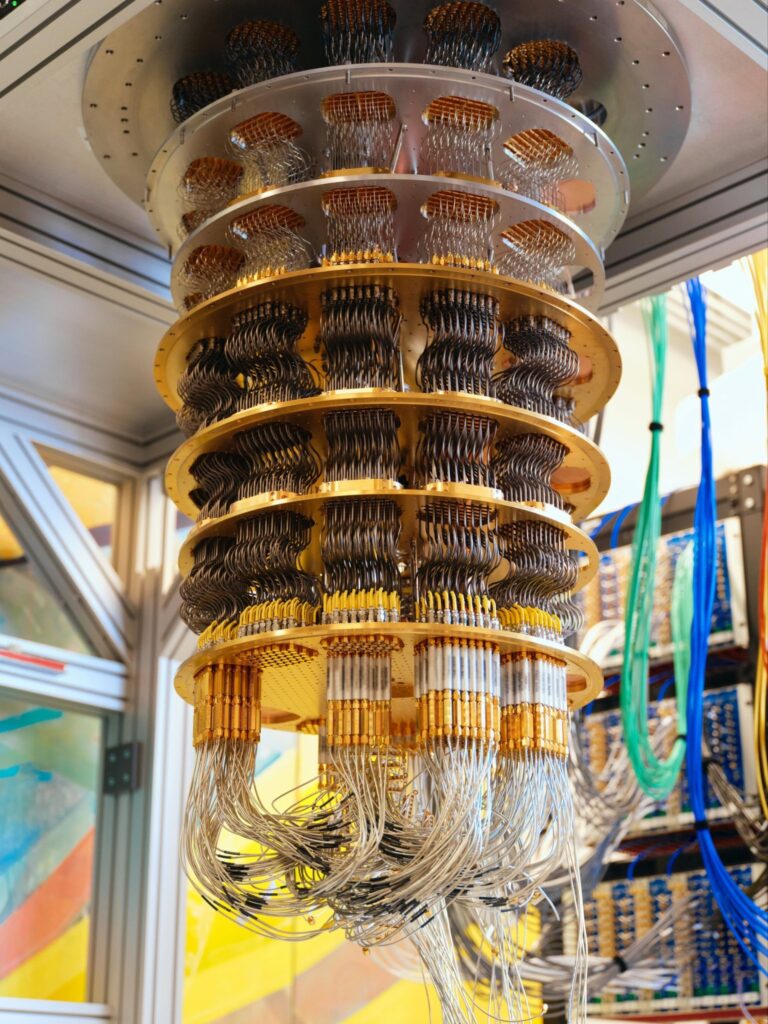
Quantum computers have spent decades as more of a promise than a product — locked away in research labs, always “a few years off” from doing anything useful. That story is starting to change. Scientists have been chipping away at one of the field’s toughest problems, and the technology finally feels like it’s inching toward the real world.
The trouble has always been noise. Not the kind you hear — the kind that ruins everything. A tiny vibration, a slight shift in temperature, even stray electromagnetic interference can scramble the delicate quantum information stored in qubits, the basic building blocks of a quantum computer. It’s a bit like trying to balance a house of cards in a room where someone keeps bumping the table. For years, this fragility made it nearly impossible to trust quantum computers with anything important. But researchers have found a workaround: linking several physical qubits together to form what’s called a “logical qubit.” This bundling trick cuts down on errors and lets the system hold onto useful information for much longer than before — a genuine breakthrough, not just an incremental tweak.
Why does any of this matter to the average person? Because quantum computers are uniquely good at chewing through problems with an almost absurd number of possible combinations — the kind of math that would leave even our best supercomputers running for thousands of years. Drug companies are already poking around with quantum simulations, trying to model how molecules behave and interact, hoping to speed up the painfully slow process of discovering new medicines.
Banks are watching closely too. Quantum algorithms could reshape how financial institutions calculate risk and build investment portfolios. Meanwhile, over in cybersecurity, there’s a quieter kind of panic brewing — experts are racing to build “quantum-resistant” encryption before today’s security standards become obsolete. The worry is real: a sufficiently powerful quantum computer could, in theory, crack codes that currently protect everything from bank accounts to state secrets.
Still, don’t expect a quantum laptop on your desk anytime soon. Most researchers agree that fully reliable, large-scale quantum computers remain years away. The machines we have now are limited in size and mostly confined to labs and specialized research projects rather than everyday use.
But the pace of progress lately has surprised even the skeptics. What once sounded like science fiction is steadily turning into an engineering problem — and increasingly, one that researchers believe they can actually solve.