By Sofia Pan, G8
In 1945, an engineer named Percy Spencer was standing next to an active military radar
machine when he noticed a bizarre sensation in his pocket. His chocolate candy bar had
completely melted into a warm, gooey mess. Instead of getting annoyed, Spencer got
curious. He placed a handful of unpopped popcorn kernels near the machine next—and
watched them explode all over the lab. Without realizing it, he had just accidentally birthed
the modern microwave oven.
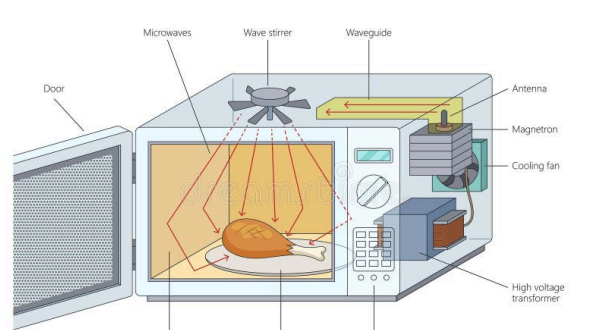
At the heart of this invention are “microwaves.” Despite the tiny-sounding name, these
waves actually have a wavelength of about 12 cm—hardly microscopic! They earned the
prefix “micro” in the 1930s simply because they were vastly shorter than the kilometer-long
radio waves used for broadcasting at the time. Powered by thousands of volts surging from a
high-voltage transformer, these waves are generated by a device called a magnetron. They
shoot down a metallic tunnel called a waveguide, pass cleanly through a protective mica
sheet, and enter the cooking cavity. Here, they bounce off the metal walls like a hall of
mirrors, using a rotating turntable to ensure your food passes evenly through the resulting
crossfire of energy.
Have you ever bitten into a microwaved pastry only to find the fruit filling is molten lava while
the outer crust is barely lukewarm? This creates a famous culinary illusion: that microwaves
cook food from the inside out. In reality, heat always travels from the outside in, but
microwaves are highly selective. They pass right through air, glass, and dry flour, targeting
only three main things in your food: water, sugar, and certain fats. Why? Because water and
sugar molecules are polar, meaning they possess distinct positive and negative
ends—acting just like microscopic magnets. As the microwave’s electromagnetic wave
sweeps through the food, its electrical charges flip back and forth a staggering 2.45 billion
times per second. Attracted to these shifting energetic zones, the polar molecules are forced
into a violent, hyper-speed spin on the spot. This subatomic dance party creates immense
friction, transforming kinetic energy into the heat that cooks your lunch.
The brilliant engineering of a microwave goes far beyond what meets the eye. The entire
metal cabin acts as a reversed Faraday cage, designed not to keep electricity out, but to trap
radiation in. Look closely at the glass door, and you will see a fine metal mesh grid. Because
the invisible microwaves inside have a bulky 12cm wavelength, they are physically too
massive to squeeze through holes that are only a few millimeters wide; they simply slam into
the mesh and bounce back inside. Meanwhile, visible light possesses a microscopic
wavelength under a single micrometer—small enough to glide effortlessly through the gaps,
allowing you to safely watch your cheese melt!
Next time you press “Start” to heat up a snack, take a moment to appreciate the invisible
symphony playing out behind the glass. From a messy, melted chocolate bar in a 1945 radar
lab to a high-voltage dance of billions of spinning polar molecules, the microwave oven is a
masterclass in physics. It is an appliance that transforms a fundamental law of
electromagnetism into a hot meal—proving that sometimes, the most revolutionary scientific
breakthroughs are hiding in plain sight, right on your kitchen counter.