By Sofia Pan, G8
It is estimated that over 70 aircraft are struck by lightning every day worldwide, yet news and
podcasts aren’t overwhelmed with news of plane accidents. In fact, the plane is the safest
place for you to be in during a storm. To uncover the reason, you’ll have to dive into the
history of the Faraday Cage.
In 1755, Benjamin Franklin lowered a cork ball into an electrified silver can to see how
charges distribute themselves across odd shapes, discovering that electrical forces
completely vanished inside. Later on, Henry Cavendish in 1773 blasted a hollow metal
globe with electricity, demonstrating that the charge stayed entirely on the outside. Building
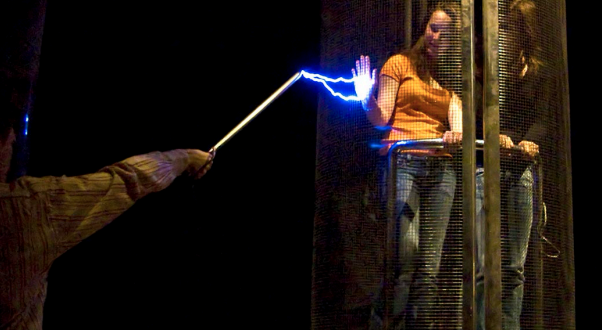
directly on these discoveries, Michael Faraday constructed a massive, foil-lined room in
1836, locking himself inside with an electricity detector, and cranking the exterior up to a high
voltage. When his detector stayed at zero while sparks flew on the outside, he proved that
metal enclosures act as a perfect shield, giving birth to the Faraday cages.
The specific physical design of an airplane functioning as a Faraday cage became
standardized in 1935 with the introduction of the Douglas DC-3 in 1935, the first
commercially successful all-metal airliner. Since then, international aviation safety laws have
strictly mandated that every commercial aircraft must be engineered to maintain the
continuous, unbroken electrical shield.
When an external electric field or electromagnetic wave hits the cage, the freely moving
electrons in the conductive material are instantly attracted to the positive side of the external
field. Leaving the other side of the material with a shortage of electrons, giving it a positive
charge. This creates a brand new, internal electric field—the secondary field. Because the
external and internal fields are equal in strength but point in totally opposite directions, they
neutralize each other perfectly. This is the electrostatic shielding principle, which acts as the
foundation of the Faraday cage. More surprisingly, the process only takes about a
femtosecond, which is a quadrillionth of a second (0.000000000000001 seconds), so the
outside electricity never gets a single moment to slip inside the cage.
The Faraday cage’s application goes far beyond protecting passengers in aircraft, it ranges
from medical shielding (MRI rooms), everyday life safety insurance, to securing sensitive
data or electronics from interference.Yet, the story of the Faraday Cage doesn’t end here.
How to get out safely from the cage? Will another invention be inspired by the Faraday Cage
emerge? Never undermine your potential, because you may be the one to complete the
story of the Faraday cage.