By: Sofia Pan, Grade 9
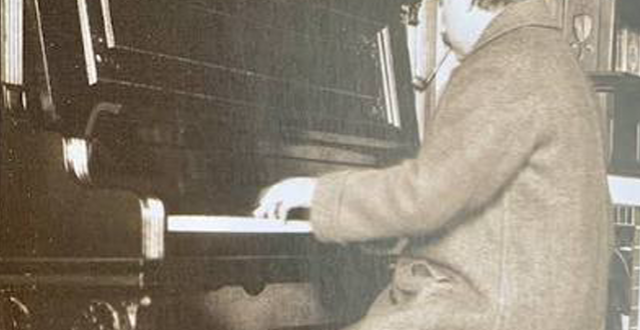
According to family accounts, whenever Albert Einstein found himself stuck on a complex mathematical or scientific problem, he would abruptly get up from his desk and walk towards the piano. He would play for a short while, and then suddenly, his face would light up. You might wonder what’s so magical about the piano such that it could enlighten one of the most well-known physicists in the world. The secret isn’t magic—it’s neuroscience.
Scientists have found that playing music creates strong brain activity in both the left and right hemispheres, which increases activity in the corpus callosum (the bridge between the left and right hemispheres). This repetitive firing signals specialized cells (oligodendrocytes) to wrap a substance called myelin around the axons (the wires connecting your neurons). Myelin acts like an electrical insulator, speeding up the transmission of data. This allows the creative right brain and logical left brain to communicate instantly, helping physicists bypass the mental block and find a creative and fresh solution.
Yet, its benefits stretch far beyond. Playing the piano will also help your brain to master advanced multitasking and high-level parallel processing. Since the polyphonic instrument regularly requires you to read and play two completely different streams of data with your left and right hand at the same time, the brain must override its natural mirror-movement settings. It relies heavily on the supplementary motor area (SMA), a region responsible for planning complex sequences of movements. This will strengthen the brain’s ability to mentally blueprint movements before performing them and speed up physical response times in both music and daily activities.
In addition, playing the piano enhances your memory, bringing you one step closer to becoming the “big brain” in your class. When playing, you must remember the notes, rhythms, and dynamics of a piece, as well as any changes in tempo or key. This requires using both short-term and long-term memory, stimulating the growth of new neurons and strengthening the synapses connecting them.
Intensive memory training also physically enlarges the hippocampus, which is the brain’s primary hub for long-term storage. Ultimately, you learn invaluable memorizing skills, for example shifting from passive reading to active translation, converting boring data into vivid, unforgettable mental imagery. As a result, you will build memory skills that make your learning faster and sharper across the board.
Albert Einstein once remarked that “the greatest scientists are artists as well”. In this world where AI and technology dominate, don’t forget to carry the bits and pieces of artistry and creativity with you, it can be playing the piano, dancing, designing, or anything that brings you simple pleasure. That’s what makes your work unique and distinct from AI.